


Amanda Knox and her family endured a day arguments by prosecutors today who retraced their accusations against her, presented grisly autopsy photos of murder victim Meredith Kercher, and warned jurors that a media campaign was interfering with Italian justice.
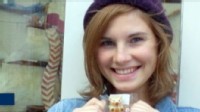
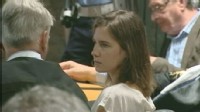 Knox entered the courtroom this morning looking tense and anxious as the summations in her appeal began. Knox has gotten her hopes up that the appeal will exonerate her and allow her to go home to Seattle after four years in an Italian prison. She obviously is also afraid that her appeal could be denied.
 "I was worried about Amanda because she was understanding every word, lies about her," her mother Edda Mellas said at the conclusion of the day's legal procedings. "I knew it would be hard for her."
Her mother said she saw Knox briefly during a break. "I told her to hang in there. She said she was okay," Mellas said.
"It's emotionally draining because we worry about Amanda," Mellas added.
Her father, Curt Knox, said of the prosecutors' arguments, "It's a struggle to deal with. We knew it was coming and hopefully she will be strong enough to endure it."
Amanda Knox Prosecutor Claims Media Interference in Trial
Knox, 24, and her ex-boyfriend Raffaele Sollecito, 27, were convicted in 2009 of murdering Knox's British roommate Meredith Kercher. They have been in prison since shortly after Kercher's partially nude body was discovered with her throat slashed in November 2007.
There has been growing speculation that Knox and Sollecito could win their appeal and be freed because court appointed experts have raised damaging questions about the prosecution's DNA evidence. Prosecutors, however, appeared determined to keep Knox in prison to finish serving her 26 year prison sentence.
A reporter's odyssey with Amanda Knox
Prosecutor Giuliano Mignini stated that there has been "heavy interference" in the trial, a thinly veiled reference to the recent press coverage of the appeal, and urged the panel to proceed with their deliberations in a "rigorous way."
He took a bare knuckle approach in defending his case and began the summation by almost immediately presenting the jury with a slideshow of photos that included pictures of bloodstains in the house where Kercher died as well as photos of Kercher's slashed body. The blood-filled pictures included close-ups of the wounds. Several jurors looked away.

The prosecutors reviewed much of the circumstantial evidence surrounding the case and said, "All clues converge toward the only possible result of finding the defendants guilty."
They also appealed for the jurors to not be swayed by the press coverage that has been critical of the prosecution's handling of evidence and what is perceived to be a growing sentiment for Knox and Sollecito. Mignini called it "media clamor," and added, "This is not a media fiction... This case has to tried and decided here."
Mignini warned of what he called "systematic denigration of the Italian justice system in the media," and scathing criticism of the DNA evidence surrounding a knife that was allegedly the murder weapon and Kercher's bra clasp that allegedly had Sollecito's DNA on it.
"Don't commit a grave error..it would be unforgivable," Mignini warned. "It's not just about the knife and the bra clasp. There are lots of other things."
The prosecutor spoke emotionally of the day he was called to the Perugia cottage to begin his investigation.
"I still remember the wide open eyes of the victim, and the composed, immense pain of her parents," he said.
Another prosecutor, Giancarlo Costagliola, urged the jury, "As you make your decision, I wish that you jurors feel a little bit like the parents of Meredith Kercher, a serious, studious girl whose life was taken by these two kids from good families."
A team of prosecutors is expected to present its case through today and into Saturday. A lawyer for Kercher will also get to make a summation before lawyer for Knox and Sollecito get to speak. Before the jury retires to consider a verdict, Knox and Sollecito will get to make statements on their own behalf. A verdict is expected in the early days of October.
The Knox family has told ABC News they are trying to keep their emotions and hopes in check. Knox's stepfather Chris Mellas called it a "combination of dread and hope."
Edda Mellas told "Good Morning America, "We are not going to celebrate until she walks out, but definitely we are feeling this could be the end of the nightmare."
Amanda Knox's Appeal in Final Days
The family, like Knox, was very serious and tense in the courtroom today. During early statements Knox only looked straight ahead or down, occasionally writing notes.What is fueling the family's hopes is the testimony during an earlier phase of their appeal this summer.
Two court-appointed independent experts reviewed two key pieces of evidence in the case. One crucial piece of evidence is Kercher's bra clasp, allegedly with Sollecito's DNA on the hook, that was collected six weeks after the murder. The second is a kitchen knife found at Sollecito's apartment. The prosecution claims it's the murder weapon and has Kercher's DNA on the blade and Knox's on the handle. Amanda Knox Trial: A Producer's Perspective Watch Video
After a three month review, the independent experts concluded that the evidence was likely contaminated and testing results were inconclusive.
The independent experts also scolded prosecutors for the way they handled the DNA evidence.
During the appeal, they played video of the crime scene collection after explaining basic evidence collection standards: place evidence in paper, not plastic bags, change gloves frequently and gently swab for DNA, don't rub. As the video showed evidence placed in plastic bags, gloves not changed and cotton swabs rubbing surfaces, some spectators gasped in horror while others laughed.
Most notable was the collection of the bra clasp, already controversial because it was collected six weeks after the murder. The video showed forensic police picking up the clasp, handing it to one another, placing it back on the floor, photographing it and then picking it up again. The independent experts said the substance on the knife blade was starch, specifically rye bread, not Kercher's DNA. They argued that the amount of DNA was too minuscule to have been tested in the first place.


